The Challenge
As in-flight connectivity becomes a core passenger expectation rather than a premium add-on, airlines are under increasing pressure to balance customer experience with monetization. Pricing models for in-flight Wi-Fi vary widely across regions, routes, service quality, and provider partnerships, creating a fragmented and complex competitive landscape. The client, a global aerospace stakeholder, wanted a clear and comparable view of how airlines across the U.S. and Europe structure Wi-Fi pricing for domestic and international flights. Without standardized benchmarks, it was difficult to evaluate competitive positioning, assess pricing flexibility, and anticipate emerging trends shaping passenger willingness to pay.
Key Questions Addressed
- How do in-flight Wi-Fi pricing models differ between U.S. and European airlines?
- What pricing variations exist across domestic versus international routes?
- How do service providers influence pricing tiers, speed, and package design?
- What differentiation strategies are airlines using to improve adoption and revenue?
- Which emerging pricing trends can inform future connectivity strategies?
Our Approach
ExpertLancing deployed a multi-step research and benchmarking methodology to deliver clarity on the in-flight Wi-Fi pricing landscape:
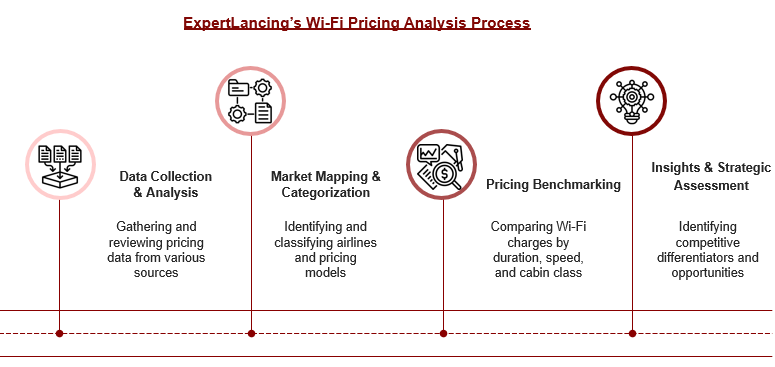
1. Data Collection & Analysis
- Gathered publicly available pricing data from airline websites, booking interfaces, and in-flight service providers.
- Reviewed industry reports, whitepapers, and press releases for market-level insights and emerging trends.
2. Market Mapping & Categorizationv
- Identified major U.S. and European airlines offering in-flight Wi-Fi services.
- Classified pricing models by domestic vs. international routes and provider partnerships (Gogo, Viasat, Inmarsat, Panasonic Avionics).
3. Pricing Benchmarking Benchmarked Wi-Fi charges by:
- Duration : Hourly, full-flight, and subscription plans.
- Speed & Data Tiers : Basic browsing vs. high-speed streaming.
- Cabin Class Segmentation : Economy vs. premium class pricing.
4. Insights & Strategic Assessment
- Identified competitive differentiators and emerging pricing trends.
- Highlighted opportunities for pricing innovation and customer experience enhancement.
The ExpertLancing Impact
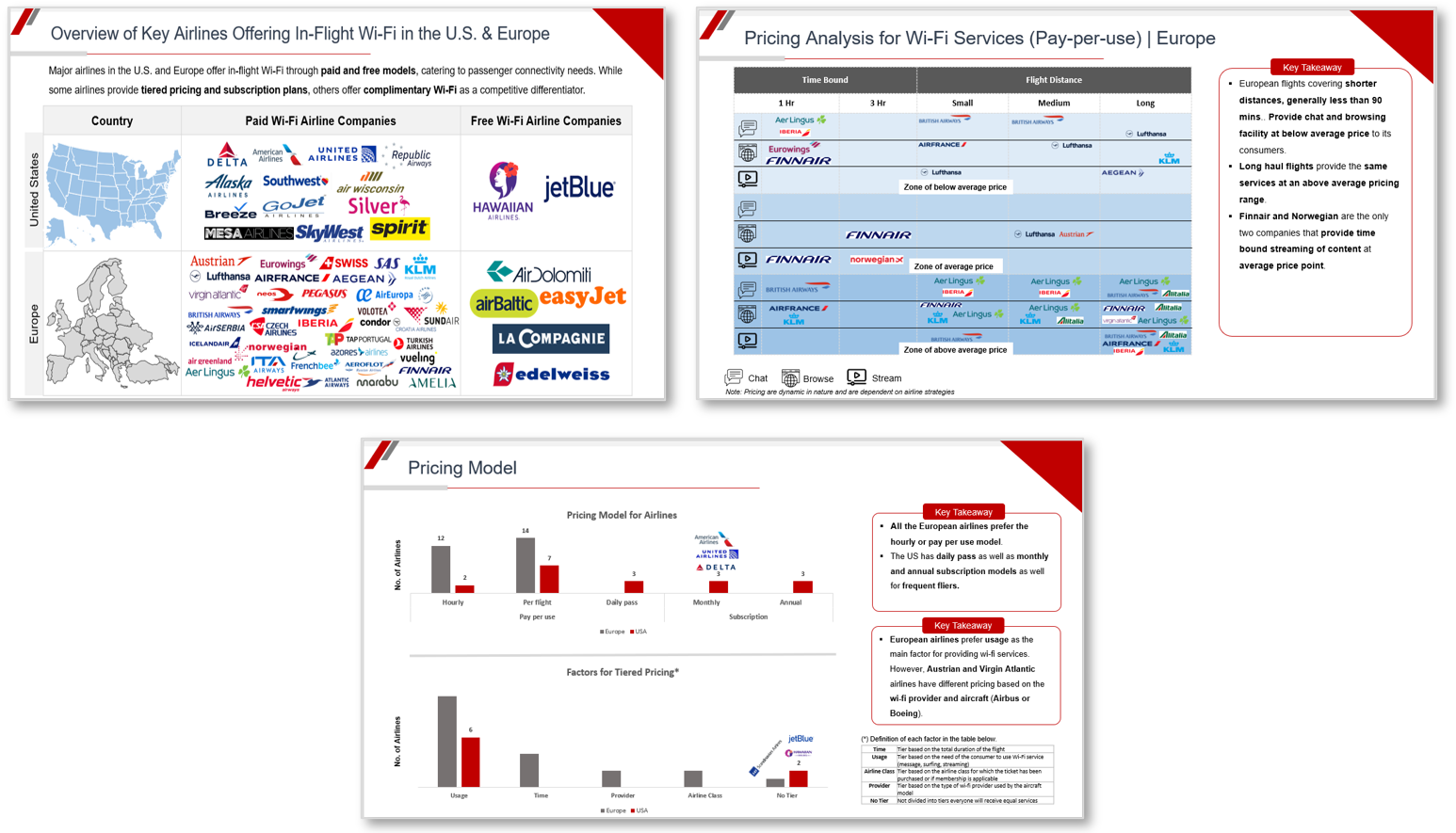
Through this structured benchmarking, ExpertLancing provided the client with a clear and comparative view of in-flight Wi-Fi pricing models, uncovering:
- Significant variations in pricing strategies – U.S. carriers leaned toward flat-rate and subscription-based models, while several European carriers emphasized tiered pricing by data consumption and streaming capability.
- Route-based differentiation – International flights carried 20-50% higher Wi-Fi charges on average due to bandwidth and satellite costs.
- Emerging flexibility trends – Several airlines introduced hourly micro-packs and loyalty-linked connectivity perks, signaling a shift toward personalization.
- Provider influence – Partnerships with premium providers like Viasat and Inmarsat correlated with higher speeds but also premium pricing tiers.
Are you ready to sharpen your competitive edge in in-flight connectivity and digital passenger experience? Partner with ExpertLancing to uncover actionable pricing intelligence, benchmark market leaders, and future-proof your connectivity strategy. Contact us today to start your journey toward smarter, data-driven decisions in an evolving aviation ecosystem. Together, we help you turn connectivity into a strategic advantage.